When Your LLC Formation Date Differs From Filing Date (2026)
If your LLC's formation date is different from its filing date, Section 206(a)(2) of the NY LLC Law requires your publication ad to include both dates. Most LLCs have identical filing and formation dates, so this never comes up. But when the dates differ — even by a single day — your notice must state the filing date and the formation date. Omitting the formation date means your ad does not fully comply with the statute, which could require republication and restart the six-week clock.
Formation Date vs Filing Date

What Section 206 Requires When Your Dates Don't Match
Section 206(a)(2) of the New York Limited Liability Company Law specifies exactly what information your publication notice must contain. Among the required elements is:
"the date of filing of the articles of organization with the department of state and, if the date of formation is not the date of filing of the articles of organization, the date of the formation of the limited liability company"
This means the law has a conditional requirement:
| Scenario | What Your Ad Must Include |
|---|---|
| Filing date and formation date are the same | Just the filing date (which is also the formation date) |
| Filing date and formation date are different | Both the filing date and the formation date |
The distinction matters because Section 203(d) of the NY LLC Law allows an LLC to specify a formation date up to 60 days after filing. When someone exercises that option, the filing date (when DOS processed the paperwork) and the formation date (when the LLC legally came into existence) are two different dates.
Section 206 is the only NY LLC publication statute with this conditional dual-date requirement. The PLLC statute (Section 1203) and foreign LLC statute (Section 802) do not have this provision.
How the Filing Date and Formation Date Can End Up Different
For the vast majority of LLCs, both dates are identical — the LLC becomes effective immediately upon filing. But there are two common scenarios where dates diverge:
Scenario 1: You Requested a Future Effective Date
When filing your Articles of Organization with the NY Department of State, you can request a future effective date up to 60 days out. This is common when:
- Starting a business on January 1st but filing paperwork in December
- Coordinating LLC formation with a business acquisition closing
- Aligning formation with the start of a tax year
- Waiting for a professional license before the LLC officially begins
Example: You file on December 15, 2025 and request a formation date of January 1, 2026. The ad must include both: "filed...on December 15, 2025. Date of formation: January 1, 2026."
Scenario 2: End-of-Day Filing Processed the Next Business Day
This is the scenario that catches people off guard. In some cases, when Articles of Organization are submitted near the end of a business day, the Filing Receipt may show a "FILE DATE" and "EXISTENCE DATE" that differ by one day. The exact reason varies — it may relate to DOS processing timing or how the effective date was recorded — but the result is the same: two different dates on the receipt.
Example: We have seen cases where the filing date was March 5, 2026 and the existence date was March 6, 2026 — a one-day difference. Even though the dates differ by just one day, Section 206(a)(2) requires both dates in the notice.
One Day Matters
Even a one-day difference between filing date and formation date triggers the dual-date requirement under Section 206(a)(2). There is no "close enough" exception in the statute. If your Filing Receipt shows two different dates, both must appear in your publication notice.
What a Compliant Publication Ad Looks Like
Here is the difference between a standard one-date notice and a compliant two-date notice:
Standard Notice (Dates Are the Same)
"EXAMPLE LLC. Arts. of Org. filed with the SSNY on 03/05/2026. Office: Albany County. SSNY designated as agent of the LLC upon whom process against it may be served. SSNY shall mail copy of process to the LLC, 123 Main Street, Albany, NY 12207. Purpose: Any lawful purpose."
Two-Date Notice (Dates Are Different)
"EXAMPLE LLC. Arts. of Org. filed with the SSNY on 03/05/2026. Date of formation: 03/06/2026. Office: Albany County. SSNY designated as agent of the LLC upon whom process against it may be served. SSNY shall mail copy of process to the LLC, 123 Main Street, Albany, NY 12207. Purpose: Any lawful purpose."
The only difference is the addition of "Date of formation: 03/06/2026." immediately after the filing date. This single sentence satisfies Section 206(a)(2).
Note that the phrase "Arts. of Org. filed with the SSNY on 03/05/2026" is how the statutory "date of filing" appears in the notice. The formation date clause is then added as a separate sentence. For guidance on which date to use when both dates are the same (the vast majority of cases), see our companion article.
What Happens If You Only Include One Date
If your dates differ and your ad only includes the filing date (omitting the formation date), several things can happen:
Technically non-compliant notice. The ad does not contain all the information required by Section 206(a)(2). While Section 206(c) provides a general presumption that a published notice is in compliance, this presumption is meant to cover minor variances — not the deliberate omission of a required element.
Potential republication. If the non-compliance is identified before the Certificate of Publication is filed, you may need to correct the notice and restart the six-week publication period. This means additional newspaper fees, a longer timeline, and a risk of missing the 120-day deadline.
Practical reality. Many newspapers and even the Department of State may not catch a missing formation date, especially if the dates are only one day apart. But "probably won't get caught" is not a compliance strategy. The entire purpose of publication is to satisfy a legal requirement — doing it correctly the first time eliminates any risk. If you are unsure whether a notice needs correction, consult with a qualified attorney.
Ready to skip the hassle?
We handle everything — newspapers, affidavits, and state filing.
Get StartedHow to Check If Your Dates Are Different
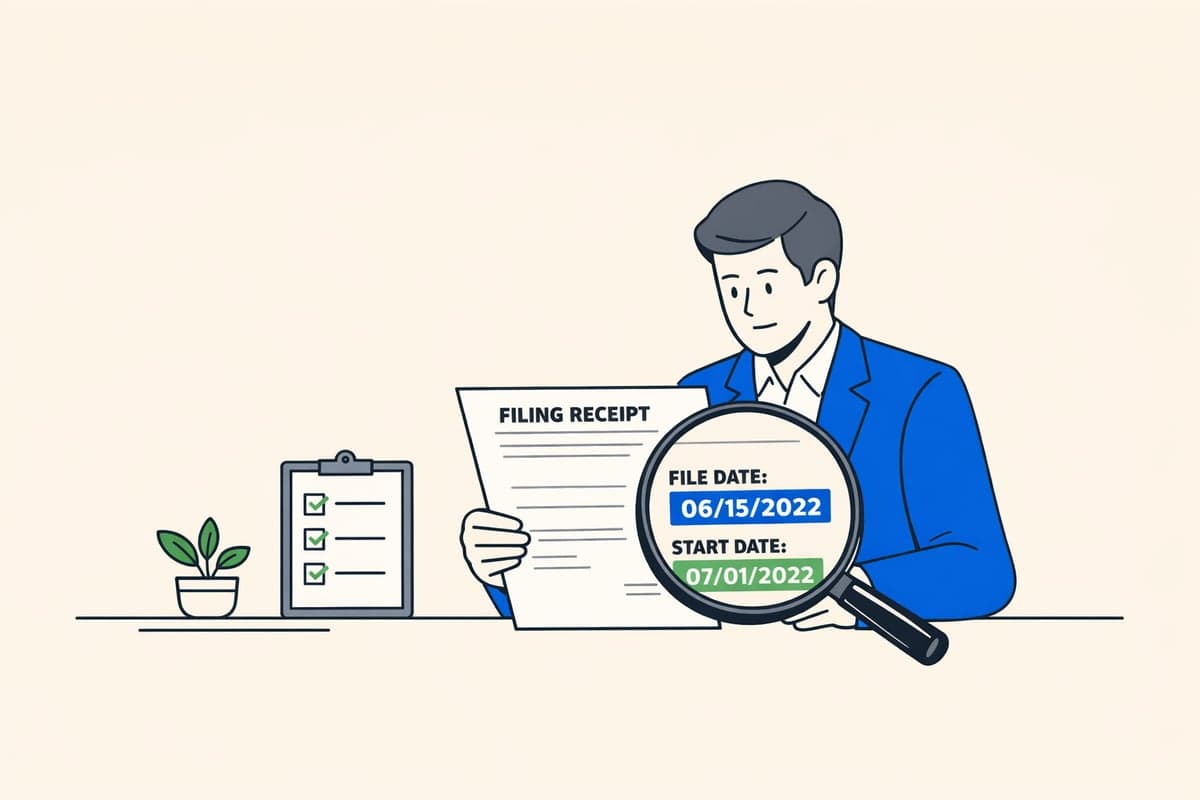
Before starting publication, verify both dates:
1. Check your Filing Receipt. The Filing Receipt from the NY Department of State shows two labeled fields:
- FILE DATE — when DOS processed the filing
- EXISTENCE DATE — when your LLC legally came into existence (the formation date)
If these are the same, it is a standard single-date situation. If they differ, Section 206(a)(2) requires both dates in the ad.
2. Check the DOS entity database. Search the NY DOS entity search by your LLC name. The record shows both dates. This is useful if you have lost your Filing Receipt or if someone else filed your LLC on your behalf.
3. Check your Articles of Organization. If you requested a future effective date, it will be stated in the Articles of Organization you filed. Your attorney or formation service should have a copy.
How LLC Publishers Handles This Automatically
When you place an order with LLC Publishers, we automatically verify your LLC's dates against the NY Department of State records. Our system:
- Pulls both dates from the DOS database — the filing date and the effective (formation) date
- Compares them at the day level
- Adds the formation date clause to your ad copy if the dates differ
- Flags the difference for manual review to ensure accuracy
You do not need to tell us about this or check it yourself. If your dates differ — whether by one day or sixty — we catch it and include both dates in the notice automatically.
This is one of the details that a specialist publication service handles that DIY filers or general formation services may miss. If you have questions about your specific situation, contact us — we are happy to help you check.
How We Maintain This Data
This article reflects current New York State law and DOS procedures as of March 2026. Our information is based on:
- Section 206 of the NY LLC Law — the statutory requirement for dual dates when filing and formation dates differ
- Section 203(d) of the NY LLC Law — definition of when an LLC is "formed" (at filing or up to 60 days later)
- NY Department of State LLC resources — Filing Receipt format and entity database
- Our direct experience processing orders where filing and formation dates differ, including verifying dates against DOS records before generating publication notices
Last verified: March 2026
This is one of those compliance details that separates a careful publication process from a careless one. Most of the time it does not matter — but when it does, getting it wrong means starting over.
FAQ
Does the dual-date requirement apply to PLLCs?
No. The dual-date requirement is specific to Section 206, which governs domestic LLC publication. Professional LLCs (PLLCs) are governed by Section 1203, which requires the filing date but does not contain the conditional formation date clause. If you have a PLLC, you only include the filing date regardless of whether the dates differ.
Does this apply to foreign LLCs registered in New York?
No. Foreign LLCs are governed by Section 802, which has different date requirements — specifically, the date of filing the Application for Authority and the date the LLC was formed in its home state. Section 802 always requires both dates (the NY registration date and the original formation date), but this is a different requirement than the Section 206 dual-date provision for domestic LLCs.
What if my dates differ by only one day — does it still matter?
Yes. Section 206(a)(2) does not include a tolerance for small differences. If the filing date is March 5 and the formation date is March 6, both dates must appear in the notice. The statute says "if the date of formation is not the date of filing" — any difference, even one day, triggers the requirement.
Where do I find my LLC's formation date?
Check your Filing Receipt — look for the field labeled "EXISTENCE DATE." You can also search the NY DOS entity database by your LLC name. Both sources show the formation (effective) date alongside the filing date. For more details, see our guide on filing date vs effective date.
Can I fix the ad after publication has started?
If publication is already in progress and you realize the formation date was omitted, you typically need to correct the notice and restart the six-week publication period. The newspaper may be able to correct future insertions, but the weeks already published with the incorrect notice generally do not count. This is why verifying dates before publication begins is critical.
Does the Certificate of Publication need both dates?
No. The Certificate of Publication (DOS-1708-f) form only asks for the filing date of the Articles of Organization. The formation date is not a required field on the Certificate itself. The dual-date requirement applies only to the publication notice that runs in the newspapers.
What percentage of LLCs have different filing and formation dates?
Based on orders we process, fewer than 1 in 100 New York LLCs have a formation date that differs from the filing date. The vast majority of filers do not request a future effective date, so both dates are identical. However, when it does happen, it is critical to get the ad right — and it is easy to miss if you are not specifically checking for it.
Key Takeaways
- Section 206(a)(2) requires both the filing date and the formation date in your publication ad when they differ — this is a conditional requirement unique to domestic LLCs
- Most LLCs (~99%) have identical filing and formation dates, so this typically does not apply
- Dates can differ when you request a future effective date (up to 60 days after filing) or due to end-of-day filing processing
- Even a one-day difference triggers the dual-date requirement — there is no tolerance in the statute
- Check your Filing Receipt for the "FILE DATE" and "EXISTENCE DATE" fields before starting publication
- This requirement does not apply to PLLCs (Section 1203) or foreign LLCs (Section 802) — only domestic LLCs under Section 206
- If you omit the formation date, you may need to republish and restart the six-week period
- The Certificate of Publication form (DOS-1708-f) only asks for the filing date — the dual-date requirement is for the newspaper notice only
- LLC Publishers automatically checks for date differences and includes both dates when needed